

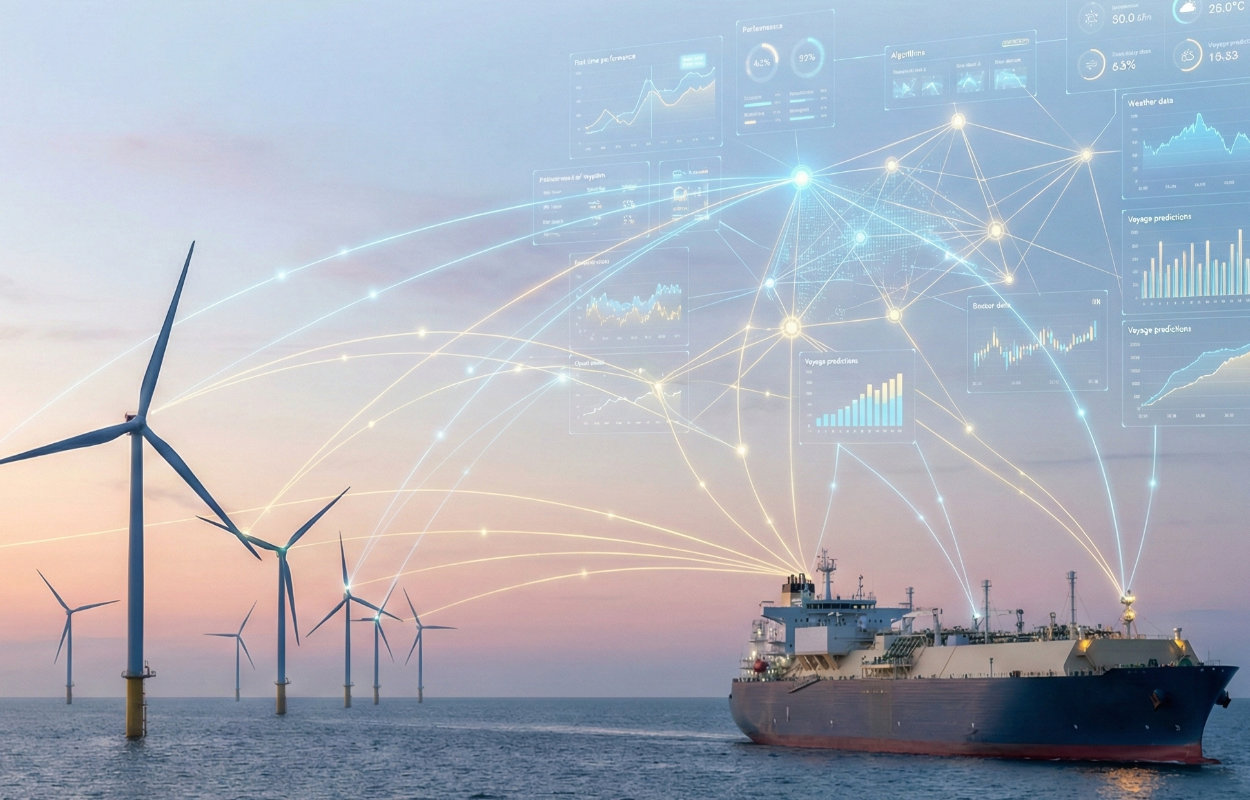
As we close out December 2025, the landscape looks fundamentally different than it did twelve months ago. This is the year we gave AI autonomy. If 2024 was the year of AI experimentation, 2025 was the year of execution.
The energy and trading sectors matured from experimental AI to production systems grounded in operational reality, where data quality and real-time decision-making became the primary competitive advantages.
To help deliver the data quality needed, we saw a shift toward hybrid talent, people who could bridge technical and commercial expertise, and teams that could modularise systems to deliver the speed that volatile markets demanded.
Here are the top themes that defined 2025 for us.
1. GenAI moved from hype to hard ROI — and leaders demanded real outcomes
Across trading, logistics, optimisation and engineering, the narrative shifted from experimentation to production deployment.
GenAI and LLMs moved into:
- Production workflows for trade support, scheduling and documentation
- Front office use cases such as signal discovery, sentiment analysis and pricing commentary
- Agentic workflows that optimised back office and operational workflows
Prompt engineering stopped being a party trick and started appearing in job specifications for AI Analysts and Developers.
Patrick Bangert, VP of AI at Oxy, captured this shift perfectly:
“AI only adds value when it mirrors the reality of the physical asset. If models drift away from operational truth, you’re optimising the wrong universe.”
2. Data quality became the biggest performance differentiator
Data lakes grew. Data trust didn’t. The companies who won this year were the ones who simplified.
As one Head of Engineering told us:
“We don’t have a data problem — we have a visibility problem. We’re flying blind in systems we built ourselves.”
2025 was the year the industry admitted that data architecture matters more than model architecture.
3. Forecasting became a strategic battleground
Short-term power, weather, fleet, congestion, vessel arrival times, renewable output and imbalance prices meant forecasting went from value add to mission critical..
In our feature naming them Innovative Company of the Year, Jua’s leadership team emphasised: Energy traders don’t want prettier dashboards – they want the truth, sooner.
“The European intraday spot markets now move in 15-minute intervals. Most traditional models give you one value every six hours. That’s too slow to act on.”
- Marvin Gabler, CEO of Jua
And from global shipping: If you can’t predict when your vessels will actually arrive, you can’t trade around reality.
“By creating a digital twin of customer vessels, combined with regularly updated weather and ocean data, we can show not just how a voyage is going but how it is likely to end: arrival times, fuel use, carbon intensity, and risks along the way.”
- Tom Melamed, Head of Data Science, 90POE, from the article Predicting Fleet Efficiency: How Data Science Powers Global Trade
The edge shifted from static curve views to probabilistic, scenario-based views that update continuously. In several firms we saw forecasting stacks that bridged meteorology, grid physics, commercial logic and risk all in one.
4. Modular, API-driven architectures replaced monoliths
2025 marked a decisive break with legacy platforms that slowed down engineering velocity.
“With modularity, you’re no longer trapped by underperforming systems. You can plug in a new risk system quite easily, what Vivek calls ‘freedom for the kidnapped firm’ when it comes to vendor lock-in.”
- Vivek Pathak, Co-founder, BroadPeak Partners from the article How Modular Systems Can Free Tech Teams in Commodities Trading
From cloud-native risk systems to event-driven trade capture, firms embraced composability as an operating principle.
5. The Rise of the “Integrator”: Talent Strategy Is Technology Strategy
The era of the isolated specialist is ending. In 2024, companies stopped hiring purely for deep technical expertise or siloed market knowledge.
Instead, one of the most valuable currencies in trading and energy technology became cross-disciplinary capability. The market prioritised “integrators”: Professionals who can translate between the worlds of engineering, data, modelling, and commercial decision-making.
Key Drivers:
The market needs specialists who are also integrators. This hybrid profile has become the hardest talent to find, and the most valuable.
Modern energy problems no longer sit in silos. The highest performers are now those who can make systems, data, and commercial logic work together.
To thrive, technologists must now build depth across three interconnected dimensions: markets, technology, and data.
“The industry no longer needs isolated specialists. It needs multi-disciplined professionals who can bridge designing software and systems that connect markets, transforming data into intelligence, and applying both to the realities of global trade and energy and commodities markets.”
- Michael Slater, Chief Business Technologist, ION Commodities from the article Talent in Transition: Building the Next Generation of Energy & Commodities Technologists
On Agility:
“Most of our team didn’t start in energy, but they bring the curiosity and hustle to dive in and make an impact fast.”
- Sean Kelly, CEO, Amperon from the article Why the Future of Energy Needs ‘Big Tech’ Talent
On Context:
“You can’t just be a data scientist. You need a business and context understanding in order to work with data effectively.”
6. Systematic trading reasserted itself, but explainability became non-negotiable
From our interviews with quant leads and risk teams:
“If the trader doesn’t understand why the model made a decision, they won’t run the model.”
- From Jack Nugent, Director, Tradavex
(Article: “AI in Commodities Trading: The Battle Between Accuracy & Explainability”)
“Simplifying AI models to make them explainable often sacrifices accuracy. It’s like choosing between a wooden cart and a Ferrari: the cart is easier to understand but you’d never take it into a race.”
2025 was the year ML models had to earn trust as well as generate accuracy.
7. Instant-power, flexible-grid and clean-energy digital systems scaled dramatically
In our feature on next-generation grid technologies, one CTO summarised the shift:
Energy flexibility is now a software problem. The hardware is there – the orchestration isn’t.
As battery technology scales, software has become the real performance unlock. As John Abbott, Principal Applications Engineer at Nyobolt, explains:
“Increasingly, it’s software that’s unlocking what batteries are truly capable of.”
- From the article The Software Behind the Next Generation of Instant Power Technology
Quantum-assisted optimisation, real-time grid modelling, and IoT-driven assets moved from research papers to practical tools.
8. Risk management evolved into opportunity creation
Many firms invested heavily in next-generation risk platforms. The mandate was simple: fewer people, faster decisions, cleaner views.
In several interviews we heard:
- A shift away from bloated teams doing manual reconciliations and spreadsheet reporting
- A move toward elite cross-functional pods shipping daily, not quarterly
- A consolidation of fragmented views of risk into a single, live picture of exposures, limits and constraints
A recurring message from risk leaders this year was clear: Volatility isn’t the threat – it’s the opportunity. But only if you can see it early, model it properly, and act fast.
“Risk and opportunity are two sides of the same coin. In commodities trading, you cannot have one without the other.
“My vision is for risk managers to evolve into opportunity managers, professionals who make risks transparent, shape smarter decisions, and unlock growth.”
- Alessio Pecorella, Head of Market Risk, Eni Trade & Biofuels from the article From Risk to Opportunity: Rethinking the Role of Commodities Risk
Risk teams moved from defence to offence.
9. Real-time decision systems became the new backbone of trading and operations
Across risk, optimisation, market analytics, logistics, asset management and grid operations, 2025 saw an industry-wide push toward systems that update, calculate and respond in real time. Not in batches, not overnight, and not “when IT gets to it”.
This shift came through strongly across multiple interviews and technical deep dives.
A leader at a global power trading firm explains: If your systems can’t ingest, compute and act on data as it changes, you’re trading yesterday’s market.
“Their batch-oriented architecture often struggles to provide timely updates… This can leave risk managers and traders making decisions based on stale or incomplete information, especially during fast-moving sessions.”
- Reza Tareen – Director and Head of Commercial at Loqsea from the article Why Cloud & SaaS E/CTRMs Are Changing The Game
And from our analysis of short-term trading risk:
“Manual oversight alone can’t keep up, and large, slow-moving organisations risk being left behind.”
- Matthew Bird, Quantile Energy from the article The Risks You Can’t See: Why Short-Term Energy Trading Needs a New Playbook.
This was the year companies realised that the speed of insight determines the speed of profit – and the technology that enables real-time decisioning has now become a competitive weapon across both trading and operations.
The Big Picture: 2025 Was the Year the Industry Grew Up
AI got real.
Data got honest.
Tech stacks got modular.
Risk teams went on the offensive.
Talent strategy finally aligned to business strategy.
And the leaders we spoke to all pointed in the same direction: Leaders from across Oxy, E.ON, Alpiq, global trading firms, clean-energy companies, and high-growth AI scaleups.
Winners in 2026 (and beyond) will be the companies who combine technology, talent, and truth.
Looking for more insights?
Get exclusive insights from industry leaders, stay up-to-date with the latest news, and explore the cutting-edge tech shaping the sector by subscribing to our newsletter, Commodities Tech Insider.